updated -14th March 2022
Workshop and showroom closed.
Whilst we no longer undertake repairs we still sell many parts including barograph charts, ink and nibs.
Our Director plans to retire (He just does not know when!)
After more than 40 years the time has come for our director to hang up his tapping hammer and move onto another phase of life. During the slow closing down period we still continue to make bespoke thermometers and glass tubes. Sell many spare parts online and especially barograph charts and ink etc.
In fact the spare parts business and new barometers will continue for some time yet, although primarily online.
Our exihibition has now closed (many items will be for sale) we still have
several antique barometers for sale but appointments are necessary before
visiting. Our restoration workshops are now closed.
NEW Barograph Paper and Ink go on Sale
Chart papers vary greatly in their composition, quality, and finish all of which affects how ink will work on the surface of the paper. Some paper will act like blotting paper soaking up the ink almost immediately, others have so little absorbency the ink runs off. That is why, here at Barometer World, we have invested heavily in specially producing a large quantity of barograph paper and now produce our own compatible ink adapted from an old Negretti and Zambra recipe. This will enable these fine instruments to be used for many years to come.
We cannot guarantee other inks will work with our NEW chart paper, although it may. Our NEW paper is especially low porosity and is not a coated paper like so many other papers these days. Our NEW paper is made in the UK not imported. From an old Negretti & Zambra recipe, we have produced our own barograph ink to suit this paper as well as the other paper we also sell while stock last. From extensive testing we know this ink works well on Our NEW barograph chart paper. However, we cannot guarantee our ink will be compatible with all existing charts, although from our tests it works reasonably well on some types of chart paper but with so many different charts still out there in circulation there is certainly no guarantee. If buying charts with our NEW paper it may be prudent to also purchase a bottle of our ink as a bottle of ink at £8.95 inc VAT is below our minium order value (£18 online or £24 by post or phone). Ensure before using you clean out the old nib well.
Barograph Charts
Have you ever wondered why barograph charts (papers) are so expensive ? - well it is almost a dark art, 100 years ago there were many types of inks (90 we heard of!) and papers for all sorts of recording instruments all around the world. With modern electronics Barographs have really become more collectable than main stream industrial instruments but there is a steady band of dedicated users that still require high quality paper for their barographs. The main paper mill 10 years or more ago was in Germany we believe but we understand that has been closed or stopped making the specialist paper we were so pleased with. Since then the market has relied upon a coated paper which whilst often being suitable can have issues with the coating not being evenly applied causing areas of bleed. Some people also try other paper types which often do not work. We at Barometer World are committed to providing charts for our loyal and growing customer base. So after a very long time we have managed to get special low absorbancy paper milled just for us - costly yes but will ensure the supply of our charts will continue for many years to come. At the same time in conjuction with the new paper we are stacking away we are developing a new ink to suit it - we think the days of bleed and blotching on barograph papers are now over for the forseeable future. You may wonder what difference this all makes, well importantly it will enable us to maintain our very competive prices of our charts for several years to come, that's good for us as we we do not have to pay ever incressing costs of paper and good for you our customer to know that just as the last few years we can hold our prices down to what we think is the lowest anywhere. see our barograph chart selection (and ink and nibs) at New Spare Parts Site
LONG AWAITED NEW EDITION
Care and Restoration of Barometers book now published
in 2nd edition, much extended and improved, a valuable asset to barometer
restorers and collectors world wide. Concentrating on the detailed restoration
of a mercury wheel barometer but with chapters on stick, aneroid and barographs.
Now 175 pages (was 116) . with attractive front cover, still in paper back.
available direct from us at www.buybarometers.co.uk
the book Aneroid Barometers and their Restoration
deals with that style in detail.
Who needs a Barometer anyway?
Sadly fewer people have bought new barometers this past quarter - well we all know what the weather is going to be 'Rain' followed by more 'RAIN'! however restoration and sales do still continue and one day we will catch up with all those repairs waiting to be done in the workshop! Surprising just how many barometers awaiting restoration we find tucked away in the store room that are gathering dust. So this wet season has enabled us to look at dusting some off and give them the special Barometer World treatment of skilled craftsmanship and time as well as a special polish where needed. There is really few better gifts than a barometer for long lasting pleasure and practical use in the home, for the Gardner, farmer, fisherman, sportsman, or keen meterologist. Make him or her a barometer tapper and continue the age old tradition of our fore Fathers.
Olympic Torch goes past Barometer World
Monday 21st May we will see the Olympic Torch whizz past us - yes- almost outside our showroom door! Never before has it ever been near our small rural village of Merton, perhaps it has been drawn towards us by the sheer number of barometers we have here or more likely someone in the know has muddled us up with Merton London - It has happened before! Mondays we close so at least we will be able to join the crowds lining the pavement and cheer the flaming torch along its way. We are even thinking of producing our very own 'Olympic Barometer' watch this space to see how we get on with it.
Barometer World on You Tube
Technology catches up with us all in time we expect. Now online with some video clips of barometers etc. Barometer World is now on You Tube! It is a useful medium to show people answers to simple questions such as 'How do I set my aneroid barometer?' and how to change a chart on a barograph. Barometer World hopes to expand the selection of video guides and information available over teh next few months to form a useful colection for the intrested barometer owner.
What do you think about InterParcel.! or The Collins Carrier Guide
Over many years we have dealt with many of the delivery companies in UK - yet are we to find any that can constantly preform well. We all know mistakes can be made, deliveries can be late, vans break down, parcels get sat on, dropped and ruined, well that is what we expect with any delivery van so we pack accordingly - we get more comments from customers about the 'Large' boxes we use than damage to barometers or parts etc. Recently we sold an item to France and used InterParcel to arrange collection and delivery, (they used DHL known by some as Drop it,Hide it or Lose it) It was duly collected and surprisingly we recevied a call from a nice guy in Ireland saying our parcel had been recieved by him, he had ordered something from UK but not what was in the parcel!. A few moments research and we discover that the DHL driver had put someone elses label on our parcel so it had our customer address as printed from the e-mail recieved from InterParcel on it and another that the driver put on (incorrectly) to an Irish address - OK so we have to sort the problem, try and contact Interparcel, not easy - if you want to phone them you have to pay 10pence a minute for the priviledge of their mistake! or e-mail and wait a long time for any reply, this is urgent, our customer in France wanted it for Friday and now it is Tuesday after. So we wait, we contact the nice Guy in Ireland to expalin what seems to have happened and what we are doing, we contact our customer in France to expalin, and we wait. we get an e-mail from InterParcel wanting copy of reciept from driver and hey - it has gone 5pm and InterParcel work between 9am and 5pm - another day goes by. Eventually InterParcel get the drift and then find out that the item can not be sent to France as DHL have arranged to return it to the sender - in the meantime this is Friday a week after it should have arrived and we arrange a 2nd item to be set to France customer. So when do we get the returned item - well we don't - we get a call from another very nice guy 7 miles away saying a parcel of ours has been delivered to him, would we like to go and collect it! I expect you guessed it - well any one with an ounce of common sense can tell the wrong lable was on it so it was returned to the wrong address - you can explain such simple matters till the cows come home but to get Interparcel to act accordingly is either not within the scope of their comprehension or ability. SO eventually Interparcel apologies for any inconvience - what hollow words by e-mail! I am now opening an account with FedEx - well they probably won't be any better, but I think Tom Hanks deserves a try!
Common sense rules to continue antique barometer restoration.
Barometer World is pleased to announce that following discussions
with MEP Giles Chichester and MP Geoffrey Cox as well as senior members
of DEFRA and the Environment Agency, the intention of the E.U. not to effect
antique restoration has been interpreted as to allow the replacement of
missing or damaged mercury thermometers on the odd occassions when required
to conserve such instruments for future generations to enjoy. It is pleasing
to comment that following an exchange of information and concerns raised
that this sensible approach has been achieved by those in a position to
act, in a common sense manner, to what was certainly a misunderstanding
and lack of clarity of the issues concerned.
" So often we hear of the 'heavy hand' of authority not listening,
in this instance there has clearly been some rational discussions and commitment
to move forward together. I am thankful to all those involved for their
due consideration and proffesional approach to the issues raised."
Philip Collins, Director of Barometer World Ltd, (Fellow of the Royal Met.
Society )
Barometer World threatened with enforcement action for supplying less than 20 grams of mercury in a few thermometers made since 3rd April 2009
Under the new E.U. ban of selling new mercury barometers we understood (as did every one else we thought) that barometers were allowed to be restored and we have supplied up to 7 thermometers to trade and public which average 2 or 3 grams of mercury for barometer restoration purposes made after 3rd April 2009. It seems the E.A. think a barometer with a thermometer on it are 2 different instruments and although both are over 50 years old the supply of a thermometer made after 3rd April 2009 to repair the thermometer breaches the regulations. The supply of 500 grams of mercury in a new tube to repair the barometer seems to be within the rules. But if you have an antique barometer originally supplied with a merucry thermometer (originally used to compensate for mercury expansion when reading the barometer) and the thermometer is missing or broken we (and any one else) is not allowed to provide a new mercury thermometer to put the barometer into good order again and sell to a member of the general public.
'This latest twist in the situation seems unbelievable, especially as we think even the E.U. thought repairs of antique barometers were unaffected by the regulations. It seems we have been misled yet again by someone in authority' Philip R. Collins Director of Barometer World Ltd. 5th May 2010
Part of an E.U. press release, 11th July 2007
'Antique instruments will not be affected by the proposal.'
Commission Vice President Günter Verheugen is quoted as saying "Trade in antique instruments can continue.”
Antique mercury-containing measuring devices will be exempted as such trade is limited and seems to pose no risk to health or environment.
for the full press release follow this link
11 July 2007
Commission welcomes Parliament agreement to significantly reduce use of
mercury <http://europa.eu/rapid/pressReleasesAction.do?reference=IP/07/1055&format=HTML&aged=0&language=EN&guiLanguage=en>
Our latest communication from E.A. on the subject is here:-.
Dear Mr Collins,
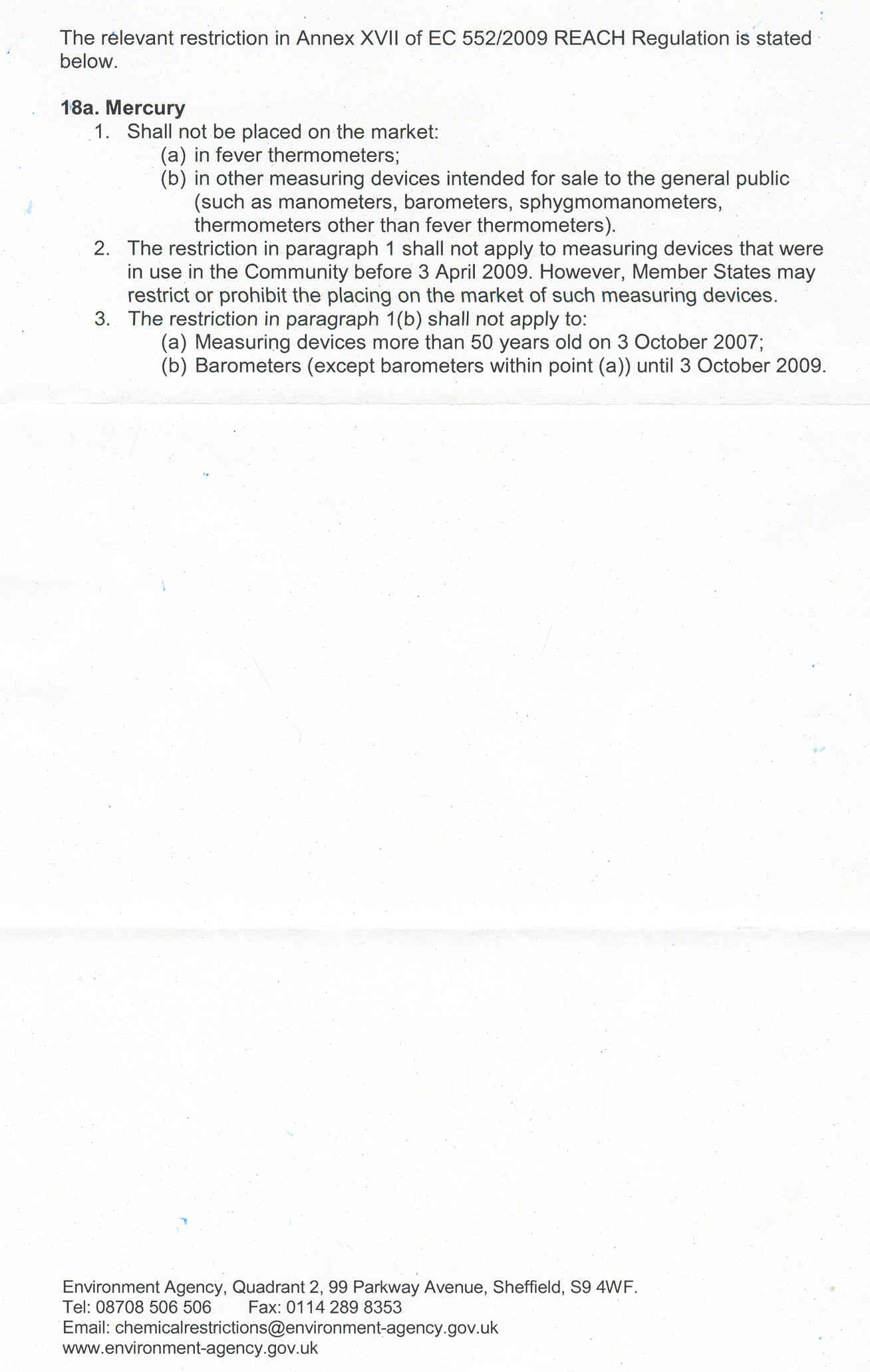
I have included the restriction covering this issue to assist with your
understanding of what you need to do to ensure you are compliant with the
law.
'18a. Mercury
CAS No 7439-97-6 EC No 231-106-7
1. Shall not be placed on the market:
(a) in fever thermometers;
(b) in other measuring devices intended for sale to the general public (such
as manometers, barometers, sphygmomanometers, thermometers other than fever
thermometers).
2. The restriction in paragraph 1 shall not apply to measuring devices that
were in use in the Community before 3 April 2009. However Member States
may restrict or prohibit the placing on the market of such measuring devices.
3. The restriction in paragraph 1(b) shall not apply to: (a) measuring devices
more than 50 years old on 3 October 2007; (b) barometers (except barometers
within point (a)) until 3 October 2009.
4. By 3 October 2009 the Commission shall carry out a review of the availability
of reliable safer alternatives that are technically and economically feasible
for mercury containing sphygmomanometers and other measuring devices in
healthcare and in other professional and industrial uses. On the basis of
this review or as soon as new information on reliable safer alternatives
for sphygmomanometers and other measuring devices containing mercury becomes
available, the Commission shall, if appropriate, present a legislative proposal
to extend the restrictions in paragraph 1 to sphygmomanometers and other
measuring devices in healthcare and in other professional and industrial
uses, so that mercury in measuring devices is phased out whenever technically
and economically feasible.'
To further clarify your queries;
1). The repair/refurbishment of a thermometer on a barometer would involve
it's replacement with either an off the shelf or custom manufactured new
thermometer and as this is clearly not part of the original barometer it
is a separate mercury measuring device under the restriction and can't be
supplied to members of the public without breaching the restriction if the
thermometer was manufactured after 3 April 2009. - If there is way of reusing/repairing
the original thermometer please supply us with the exact technique and we
will consider the validity of the procedure.
2). Any stock of thermometers you hold that you can prove were manufactured
before 3 April 2009 may still be used/supplied as they are not included
in the restriction but please be aware that we have certain information
that indicates you may have purchased thermometers that may have been manufactured
after 3 April 2009 and you would be in breach of the restriction if these
are supplied to members of the general public, either directly or in the
process of repair or refurbishment of another device and this could possibly
lead to enforcement action.
3). The restriction covers the sale of 'other measuring devices' to the
general public and as such trade sales are not affected (although if the
devices are subsequently sold on to the general public the vendor will then
be in breach of the restriction).
4). A new mercury containing thermometer manufactured after 3 April 2009
is an 'other measuring device' under the restriction regardless of the use
it is intended for, whether this individual sale or incorporation into another
piece of equipment and cannot be supplied to the 'general public'.
Regards
Kev Pitchford
Kev Pitchford
Team Leader (Regulatory) - Chemical Compliance Team
Waste and Industry Regulatory Service
Environment Agency
Quadrant 2, 99 Parkway Avenue, Sheffield, S9 4WF
www.environment-agency.gov.uk
E U Ban on new Mercury Barometers - pressure increases!
A recent letter to us from theU.K. Environment Agency has brought a new dimension to the miss understanding and interpretation of E.U rules over restrciting new mercury barometers. To quote from their letter to us of 21st April 2010 :-
"We have found evidence of possible non-compliance with the REACH restricition on mercury devices for products placed on the market by your company. This is in relation to the placing on the market of mercury thermometers used in the repair and refurbishment of barometers intended for sale to members of the general public."
Now if there are any legal bods out there that are
willing to lend a hand (at no cost to us!) your views would be welcome.
We are working with Martin Callanan M.E.P. and the F.S.B. to try and clarify
this statement. It appears to us that despite restoration of old barometers
being allowed by the E.U. our U.K. officers at the E.A. are reading that
as being only the mercury barometer tube part, now anyone that has or knows
about antique barometers knows that many of them also have a thermometer
on them as part of the instrument and these are sometimes mercury filled.
So it seems we may be allowed to repair a fine old family heirloom but not
replace a broken or missing thermometer from it - i.e. only half restore
it! That seems to us quite different from t
LINK to Relevant REACH restriction details.
NEW TYPE OF BAROMETER UNDER WRAPS
With the ban of mercury new barometers coming Barometer World have been working on different types of alternative barometers, none really come up to scratch with a mercury barometer but trials of a special glass type of barometer are well under way and not too far in the furture it is hoped a new line of these 'Hygroid' barometers will be available to the many customers that have collected Mr Collins's creations in the past.
END OF MECURY BAROMETER MAKING
Due to E.U. legislation the placing on the market for sale of NEW mercury barometers (mostly in the U.K. that means the stick type of barometers that we were famous for making) has been banned from October 2009 - (more info on how the rangle with EU etc. went further down this page). As far as we can tell that does not effect the use, supply or sale of mercury, or the restoration or sale of old barometers both antique or 2nd hand, just new mercury barometers. As far as we are aware individuals can still make barometers for their own use, just not for sale, therefore any skilled people out there may be able to make their own and we stock a range of parts for restoration that might be suitable for some such barometers - see link to spare parts at top of this page. And of course we still stock a good selection of other new items new aneroid barometers, barographs, thermoscopes, sympiesometers etc etc.
Some wise customers have pre ordered mercury barometers but that has now ceased. We will not be selling any new mercury barometers from now on. We do however have a small limited stock of pre owned mercury barometers such as Georgian Stick type, Admiral FitzRoy, Huygens or Contra type and one or two others that are currently available but only while stocks last. If interested then do call us before travelling into the depths of the Devon countryside, we may have just sold the last one!
Barometer World - Eco Champions
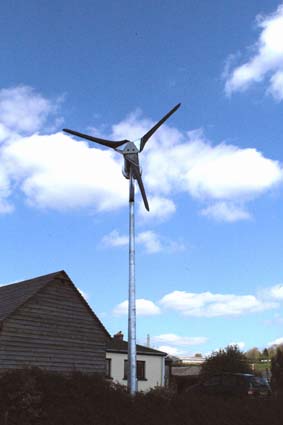
When dealing with businesses these days more consumers are becoming aware of the environmental ethics of the companies they buy from, and rightly so. Philip Collins, director of internationally famed Barometer World, has been aware of climate change and the effect of pollution for many years. As a business he tries to incorporate his personal approach to energy use, re-cycling and reducing CO2 effect. When building his current workshop and showroom nearly 20 years ago he installed a 'Kidd' condensing boiler, it still works well and being extra efficient has saved much fuel in its time. Many years ago Barometer World joined the 'Green Electricty Tariff' which although costing more per unit ensures that every unit bought is matched by the supply of equivalent renewable energy to the grid. Philip is quoted as saying.
"Being descended from a line of craftsmen and decades of restoring antiques, recycling is a way of life, repair and re use comes naturally to craftsmen, I well remember my Grandfather showing me how to straigten and re-use nails when I was only 9 or 10, I still do, why should we throw away our resources? it makes no sense environmentally or economically"
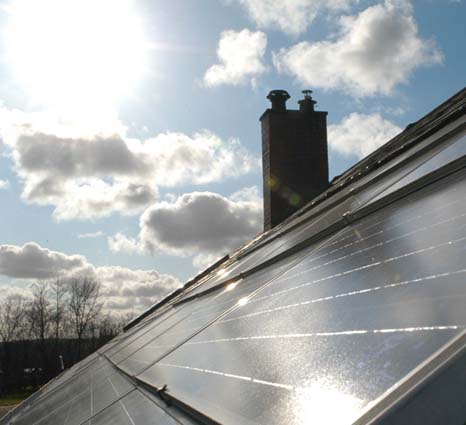
When he and his wife built their bungalow in Merton 15 years ago they installed a solar hot water system, it cost about £1450 then and has well paid for itself and is still working well. In 2006 they installed solar PV electricty generating panels and as you will see if you visit their workshop a 6kWh wind turbine, the first planning application for one in the area and much admired by most visitors also surprisingly quiet. They also threw out their oil boiler and cook and heat their home with logs bought locally using an Esse cooker. Large log piles are very evident in their grounds.
"In our business we try and recycle as much as possible, even scraps of wood can be burnt. It does cost more of course, but the world we leave is for our children and grandchildren - why spoil it for them? "
Packing barometers and parts is an area they have long been aware of recycling. Waste paper is shredded for use in packing, it makes economic sense as well these days. They even purchase sacks of shredded paper from the local primary school.
"I strongly believe in buying locally, we use local plumbers and electrictians as well as Devon suppliers for many of our office items and materials thus supporting local firms and the local economy."
The recent extension office and entrance is specially designed with the first commercially produced triple glazed windows (and high insulated doors) to be made in the UK nearby at Barnstaple. The construction is of the thermal mass kind saving energy summer and winter, with untreated natural oak weather boarding supplied by a nearby sawmills.
Philip's environmental awareness does not confine itself just to buildings, even outside the garden has been allowed to be more natural and in summer evenings Philip cuts the long Meadow grass (summer home of many insects and small mammals etc) with an old fashioned sycthe. Apparently it is relaxing as well as quiet and the blisters soon disappear!
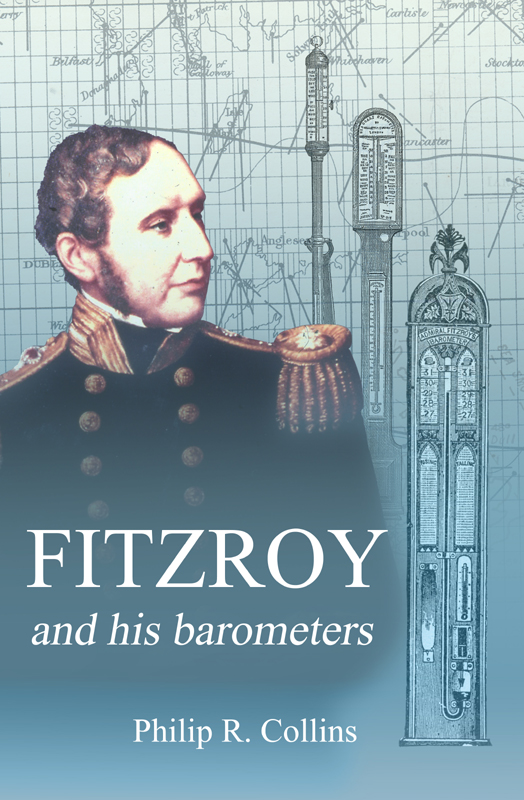
NEW BOOK - 'FitzRoy and his Barometers'
LIFE SAVING BAROMETERS
Probably the most influential person to leave a mark on that most British of pieces of furniture was Admiral Robert FitzRoy the 1st Chief of the Met Office, famous also for being the Captain taking Charles Darwin aboard HMS Beagle in 1831. In 1854 he became the head of the newly established Meteorological Office in London and soon issued barometers around the coast of Great Britain to aid in the forecast of storms and devised storm warnings to coastal areas which became very popular with local fishermen and coasters. In his lifetime these barometers on public display saved many hundreds of lives, if not thousands and his barometer guide was invaluable in explaining the rising and falling of the barometer. Long after his tragic death in 1865 the barometers and storm warning system he pioneered continued to save lives around the British coasts.
In his new book by world renowned barometer specialist Philip Collins of Merton in Devon, the role of FitzRoy & his barometers’ is interestingly explained, with an insight into this fascinating mans life and work. We can thank the current Met Office today for saving even more lives (although we seldom do), FitzRoy’s work continues using modern technology but following basic rules of weather established by FitzRoy himself.
Can be ordered online at www.buybarometers.co.uk
FitzRoy and his Barometers
By Phillip Collins
140 pages ISBN-13:978-0-948382-14-7
110 Illustrations, paperback
Retail price: £9.95 (+£2 for UK postage )
Published Baros Books
Published Nov 2007
MERCURY BAN UPDATE
For those of you that are following the mercury ban saga, here is a link to the latest legislation.
CLICK ON THIS LINK TO EU DIRECTIVE on MERCURY INSTRUMENTS
We are still trying to clarify some issues about it so watch this space.
GREAT BRITISH BAROMETER FALLS OUT OF FAVOUR! 10th July 2007
Today marked the end of barometer making in Europe after a vote to ban new mecury barometers was accepted in the EU Parliment. There were 352 votes against, and 317 in favour to suceed a total of at least 393 were needed.
HERE FOLLOWS SOME INFO FROM EU ABOUT THE BAN
Ban on sale of mercury measuring instruments - MEPs agree two year exemption
for barometers
http://www.europarl.europa.eu/news/expert/infopress_page/064-8949-190-07-28-911-20070706IPR08897-09-07-2007-2007-false/default_en.htm
The European Parliament approved, at second reading, a ban on non-electrical mercury thermometers and other mercury instruments for general sale to the public, thereby dropping its earlier call for an open-ended derogation for barometer manufacturers and accepting Council's proposal for a two-year exemption instead. The draft directive prohibiting the sale on the EU market of these devices is part of a broad strategy on mercury, a metal which is highly toxic to humans, ecosystems and wildlife.
Only last month Parliament adopted another report - on the export, import
and storage or mercury - which is also part of the strategy.
Non-electrical devices not banned until now
Electrical measuring devices containing mercury are already covered by existing
EU legislation (the RoHS directive). The main product group not yet dealt
with by Community law was non-electrical or non-electronic measuring and
control equipment, hence this latest directive.
The ban will apply to new fever thermometers for both professional and private
use, and also to "other measuring devices intended for sale to the
general public (e.g. manometers, barometers, sphygmomanometers, thermometers
other than fever thermometers)".
The ban covers only the sale of new devices. Existing instruments can still
be repaired or bought and sold second-hand.
Antiques exempted but barometer makers must switch to non-mercury devices
Parliament - whose rapporteur is María Sornosa Martínez (PES,
ES) - is highly supportive of the ban on the whole, although it suggested
a number of improvements at first reading.
The Council accepted most of Parliament's first-reading amendments, including
a demand that the Commission carry out a review of safer alternatives for
mercury-containing sphygmomanometers (blood pressure measuring instruments)
and other devices in healthcare and other professional and industrial uses.
Another Parliament amendment accepted by Council lays down that mercury
measuring devices may be traded if they are more than 50 years old, since
they are to be classified as antiques or cultural goods.
However, a further amendment calling for a complete exemption for traditional
barometer manufacturers - which Parliament adopted after hearing that such
producers constitute a valuable craft industry - was rejected by Council,
which instead proposed a two-year transition period. At the recommendation
of its Environment Committee, Parliament voted by an overwhelming majority
today to approve this alternative, along with the rest of the Council's
common position.
When does the ban take effect?
The legislation has to be enacted in national law no later than one year
after the directive enters into force (which is expected to happen in the
coming weeks or months) and must take effect no later than 18 months after
the directive has entered into force. Traditional barometer manufacturers
have an additional six months after that point, meaning their exemption
could end in late 2009.
Dangers of mercury
Mercury pollution was once regarded as an acute, albeit local, problem but
is now understood to be a diffuse, global and chronic phenomenon. Mercury
can change in the environment into methylmercury, the most toxic form, exposure
to which occurs mostly via diet. It concentrates particularly in the aquatic
food chain, making populations with a high intake of fish and seafood especially
vulnerable. Direct exposure to mercury via inhalation of vapour and absorption
through the skin is also a health risk.
Around 80-90% of all mercury used in measuring devices is used in medical
and other thermometers for household use. Many consumer products containing
mercury will end up being landfilled, which may lead to slow but long term
leaching. Mercury instruments pose a particular risk if they break in the
home.
Safer non-mercury alternatives exist for virtually all the instruments covered
by the ban. Most mercury measuring devices for consumer use (around two
thirds) are imported into the EU, so these producers will be the hardest
hit.
Debate 9 July Strasbourg, UK MEPs clash on barometers
Martin Callanan (EPP-ED, UK, North East, Conservative) , said: "The
only remaining issue to be resolved, as the Commissioner and Mrs Sornosa
Martínez pointed out, is that of barometers. I have to say that I
remain deeply convinced that both the Commission and the Council, and some
Members of this Parliament, have got the argument completely wrong. There
is no justification whatsoever for a ban on barometers. They are only being
singled out because there is only a relatively small number of companies
which still produce them in Europe and they are an easy target as far as
the Commission is concerned, to make it look as though they are actually
doing something about mercury, whereas the big sources of release of mercury
– from power stations, crematoria, etc. – are not being tackled
because, of course, to tackle them would be very expensive for Member State
governments and local authorities!
It is a completely illogical position to say that antique instruments will
be exempted but new instruments will be banned. There are probably more
antique instruments being circulated and placed on the market in Europe
than there are new instruments being created. It is a very small minority
specialist market and Europe brings itself into disrepute by delegitimising,
by banning, by forcing out of business, a small number of very entrepreneurial
and gifted craftsmen. They can be controlled by a proper licensing and control
regime which they have said that they are willing to pay for. That would
be by far the most sensible solution rather than an outright ban and to
force a number of small companies out of business, thereby losing the skills
and traditions that have existed in Europe for several hundred years."
Linda McAvan (PES, UK, Yorkshire, Labour) said: "There is an amendment
about licensing barometers. Well, that does not address the issue of spillages,
accidental damage or waste disposal, landfill and incineration. In the United
States in May, somebody found a broken barometer in a storage cupboard in
a school. The school was closed for a week. The whole school had to be evacuated
and there was a clean-up bill amounting to thousands of dollars. Sixteen
US States are moving towards mercury prohibitions on barometers and other
equipment. In fact, they are going much further than the European Commission
is proposing to go here today. So anybody who is talking about nanny-state
Europe is totally misplaced when they are looking at the barometer issue.
The PSE Group pushed for the two-year phase-out for the barometer industry.
We know these are small companies, we know it will pose some difficulties
for them, but I think they were aware of the REACH Directive coming their
way anyway, and I think this is a sensible compromise."
INFO FROM EU ON MERCURY BAN ENDS HERE IT IS NOT THE OPINION OF DIRECTOR PHILIP COLLINS
Cracking nuts with a stick of celery! Attempts by MEP Martin Callanan to place an amendment by the Environment committee to the EU parliment have been thwarted. Therefore the placing on the market of new mercury barometers will be banned 2 years after the legislation is compiled.But worry not, many people have contacted us due to some probable wrongly reported stories about old barometers being banned, as far as we are aware this is not and never has been so. There is also no restrictions planned in the current round of legislation in EU to restrict the use of mercury so you will still be able to buy mercury and build your own barometers, repair your own, store and deal in mercury as much as you like. However the new legislation effectively may see the end of British (and Europes) barometer making industry - already reduced by natural decline to a small select handful of skilled craftsmen. The arguements put forward by Labour MEP Linda McAvan include her belief that the metal element mercury is highly dangerous. Obviously Linda McAvan is wrongly informed, mercury is toxic by accumulation and under the UK Health and Safety guidelines a thresehold of 20 nmols of creatine in urine is considered the upper safe working limits. (this has been reduce from 120 and then to 60 previously but for no accountable reason as there are so few mercury workers to accumalate data from and of course no one in the EU or the UK government have bothered to contact us - why should they, they make the decisions and we just have practicle experience and working knowledge of mercury - the consultants and special advisors have the text book answers - which of course are correct aren't they?) But if you talk to senior dentists that have worked with mercury over many years you can not even see there hands shake - an early indicator of mercury toxicisity. No, the reason why EU wish to reduce mercury is because there is estimated 100's of tons of mercury vapours released into the atmosphere which can turn into Methyl Mercury and this decends onto Europe and is a considerable environmental hazard. So by stopping the less than 30 kilos of mercury in use in new UK barometers per year and perhaps the 200 kilos in Europe the MEP's have been led to believe that this will assist the considerable environmental problem in Europe. UK dentists apparently use 70 tons of mercury in fillings per year - most of us are cremated with no capture of the released mercury vapours. UK is the 2nd largest contaminator of mercury in the atmosphere from coal burning power industry (according to the EU's reports) so it makes sense to erradicate the skilled operators who recover mercury from old barometers and are best suited to advise barometer owners how best to deal with mercury. I wonder what people will do with their broken barometers in the future when no one is left to advise or assist. Perhaps they can contact Linda McAvan for assistance as she is apparently more informed than we at Barometer World are!At Barometer World we believe that mercury should be controlled by simple extension of already established methods of licencing by local councils so as to ensure all mercury used is handled, recovered and traceable in a correct and responsible maner. This would include all users not just the 3 (yes only 3 makers of barometers in UK) such as 100's of restorers of antique barometers, clock repairers (mercury in some old clock pendulms) Under the EU legislation anyone can still buy mercury, make your own barometers and other instruments - what sense is that if they thought Mercury was such a serious health threat?
The views expressed here are by Philip Colins - an experienced mercury barometer maker and restorer since 1979, he has written 5 books on barometers, appeared on numerous television programmes, written many articles and is considered a world authority on British Barometers. He has been and is consulted by many UK museums, Auction Houses, Private collectors, The National Trust, and The Met Office and many such bodies on barometer issues. In the course of his career he has taken a personal interest in and studied mercury issues. He is a fellow of the Royal Met Society.
For Press contacts please ring 01805 603443 Tuesday to Saturday 9 till 5.older newsVictory to common sense and democracy (for a change perhaps!)Todays vote (327 for 284 against) in the EU Parliment allows mercury barometers to continue to be made. The vote is not just a victory for common sense but will enable barometer owners the chance to be able to dispose of mercury through correct proceedures and we look forward to continuing to protect the enviroment from inappropriate disposal which would have risen significantly over the next decade or two, had the amendment failed.We wish to thank not only the other barometer makers in the UK and Europe that have pulled together to lobby MEP's but especially Martin Callanan and his team for putting the amendment and their support as well as The Federation of Small Buisnesses for their help in the cause.The effect will be approx a 6 month delay before it goes to 2nd reading and the detail to be arranged about licensed and controlled conditions.older news follows here.EU Plan to Ban New Mercury Barometers.Some information for Editors and other intrested people on the proposed Mercury Ban by EU Commission.Mercury UpdateLetter to Finish Presidency who are in favour of the Ban - From Mr Blockland Dutch MEPPress Release re Mercury BanInfomation sheet 1 side A4 (for MEP's)Pictures of Barometer Makers and Neil Parish MEP on recent fact finding visit.
THE VOTE for Martin Callanan's amendment to save the enviroment from indiscriminate dumping of mercury is scheduled for Tuesday 14th Novemeber 2006 - watch this space for further updates.
Background to the VOTE is:-
A small number of professional companies in the EU produce new barometers using mercury. The European Commission, however, has proposed a Directive which will ban the use of mercury in barometers. A ban would see the end of the tradition of barometer making which was begun in the mid 1600s when mercury barometers were first introduced.
This Directive has now reached plenary stage. An amendment tabled by Members from the EPP-ED, ALDE and IND-DEM, was passed in the Environment Committee to exempt barometers from the proposal in carefully controlled and licensed circumstances and allow their continued manufacture. However, the Finnish Presidency are looking to reach a first reading agreement and do not want to accept that the traditional craft of barometer making should be exempted from the proposal, despite this amendment being accepted in committee. The Presidency are supported by the Rapporteur (PES) who does not believe that the production of these instruments should be allowed to continue, and is willing to allow them to be banned.
Careful labelling and product safety warnings for usage means that people can continue to use barometers without a threat to the environment or to health. Barometers are only made by a small group of people in Europe who also carry out the repair, maintenance and recycling of historic instruments. Barometers are expensive and highly sought after. As such they are extremely unlikely to be broken up and disposed of in landfill sites. Mercury barometers are long life products that can function, if serviced approximately every fifty years, for generations. In addition, they are easily repaired and recycled.
If these businesses are forced to close, consumers will be unable to have their instruments repaired properly and will potentially dispose of them into household waste. Operators who have a good working understanding of mercury and its hazards are best placed to help reduce pollution by a licensed control system. The licensing of suitable establishments would enable use of mercury to be carefully controlled and monitored. Prohibition will make way for illegal and thus uncontrollable manufacturing and repair by non-professionals. Furthermore it will destroy the know how of handling and servicing of barometers.
Finally: the directive contains some enormous loopholes. For example: it is only the marketing of new devices that is prevented; there is nothing to stop manufacturers selling new barometers without any mercury and subsequently taking them back for "repair" at a later stage and filling them with mercury; manufacturers will be able to sell empty instruments with instructions on how to fill them with mercury yourself. This is all far more hazardous.
ENDS
Letter to Finish Presidency in favour of the ban from Mr Blokland - Dutch MEP
Ms Nina Vaskunlahti
COREPER I - Presidency
Permanent Representation of Finland to the EU
Trierstraat 100
B-1040 Brussel
Brussels, October 19, 2006.
Concerns: Mercury in Measuring Devices (COD/2006/18)
Dear Ms Vaskunlahti,
At this very moment, the Council of the European Union, the European Parliament and the European Commission, are engaged in informal meetings to find common ground for an agreement in first reading on the proposal for a directive on amending Council Directive 76/769/EEC relating to restrictions on the marketing of certain measuring devices containing mercury (COD/2006/18).
The representatives of the Council have asked the Parliament for a clarification on amendment 5, part b, that was adopted by the EP’s committee on Environment, Public Health and Food Safety. It appeared to me that the Council was rather reluctant in its way to find a compromise on this amendment, as it was unclear for the Council what our aim with this amendment is.
I would like to take the liberty to explain this amendment to you. The text of the particular paragraph of the amendment reads: By way of derogation, points (1) and (2) shall not apply to: […] (b) the production of traditional barometers using small quantities of mercury in carefully controlled and licensed environments.
I have submitted this amendment together with my colleagues Martin Callanan of the EPP-ED Group and Jules Maaten of the ALDE Group. Our aim is to safeguard the production of traditional barometers in the European Union. At this moment, only a few producers are still active in the EU. In my home country, the Netherlands, there are only two. In the UK, it concerns less than five.
The barometers they produce are not intended for professional use, but are used as decorative pieces of art. The prices normally range from 200 to 500 EUR, so it is obvious that these products are not intended for mass production or a broad public. Only mercury can be used as indicator liquid for the production of these barometers, because of its high density (13,6 kg/l). There is of course electronic equipment available on the market that can measure air pressure, but these products will not last as long as barometers, even when they are well maintained, and consequently generate more electronic waste.
Apart from this technical problem, an environmental problem will also occur when the use of mercury in barometers is prohibited: the producers of barometers now function as a knowledge base for repairing mercury containing products, and also collect mercury that is not used anymore in e.g. laboratories. In fact, most producers rarely buy mercury, as the amount of mercury offered to them by third parties for recycling is largely enough to meet their own demand.
Therefore, a ban on the use of mercury in barometers will not only lead to a loss of jobs in highly specialized companies, as no alternative liquid is available, but it can also lead to a situation in which MORE mercury is found in waste streams, as the producers are not able to function as a service facility anymore where people can deliver their mercury for recycling. Moreover, the maintenance of products currently on the market is no longer guaranteed because the income generated from maintenance operations would not be enough to keep these companies in business.
The same reasons as stated above were also taken into account by the Dutch government, when it issued a decree in 1998 that prohibited the use of mercury in any product except heating equipment, activity sensors and barometers! The derogation for barometers expired in 2005, but was extended indefinitely by the Environment ministry, as no harm to the environment was found.
May I, for all these reasons, urge you to reconsider the Council’s position on amendment 5? A ban on the use of mercury in barometers will lead to the loss of jobs in one of Europe’s last remaining traditional industries, without any real benefit to the environment.
My staff and I are of course available for any advice you might need on finding a compromise in this matter, or to reflect on possible alternative wording.
Yours sincerely,
Hans Blokland PhD
Member of the European Parliament
Vice-Chairman, committee on Environment, Public Health and Food Safety
ENDS
FOR IMMEDIATE RELEASE: Monday 23rd Oct 06
Commission Threatens 350 Year Old Tradition
MEPs and representatives of the British Barometer Makers
Association (BBMA) are fighting to save the ancient craft of barometer making
which is currently under threat from an EU Directive.
Barometers have been manufactured in the UK for over 350 years and there are currently only a few barometer makers left in the UK. If banned by the EU, the traditional art of barometer making like so many other skills will be lost, this time not because of economic decline or modern alternatives – no, this loss to will be directly due to the EU Commission.
The Directive is calling for an outright ban on all barometers because they contain mercury. However, barometers only contain very small amounts of mercury compared with other industries which are not under threat from the EU and we question why they are wasting their time on such a trivial non-strategic approach.
Philip Collins, Secretary of the British Barometer Makers Association (BBMA) said: “Recent data states that each year 3600 tons of mercury is used globally in industry, of which 300 tons is used in the EU. In the UK, less than 30 kilos of mercury is used every year in new barometers. Therefore, banning them outright would be disproportionate to the risks posed by the tiny amount of mercury they contain.
The banning of mercury barometers will not stop pollution; in fact it could become more prevalent as the general public will not know how to dispose of their barometers correctly. Without the specialist knowledge and experience of those currently working in the industry there will be less safeguards in place to prevent mercury being dumped into landfill sites around the country.”
Representatives of the BBMA have requested that a limited amount of new barometer manufacturing is allowed under licensed and controlled conditions. This would maintain the traditional and necessary skills to handle mercury in a correct manner and enable a small core of experienced workers to further advise the public on correct disposal if and when necessary.
Martin Callahan, MEP, has tabled an amendment to the Directive which will be read w/c 13th November. He said: “It is vital we get support for this amendment. We must protect the country’s heritage and companies making barometers must be allowed to continue this ancient art.”
Adding his support, Michael Fish, Fellow of the Royal Meteorological Society said: “The Met Office began with mercury barometers, I hope the EU will not end this fine traditional craft."
-ENDS-
For further press information contact: Philip Collins, Secretary of the
British Barometer Makers Association, c/o Barometer World Ltd. Merton, Okehampton,
Devon EX20 3DS. Tel 01805 603443 Fax 01805 603344, E-mail prc@barometerworld.co.uk
Notes for Editors:
· Mercury barometers were the first scientific weather forecasting
devices, once only the preserve of the wealthy, nowadays many people own
fine antique instruments that have often survived hundreds of years.
· The Barometer was first invented in 1644 in Italy and soon after
introduced into Britain by the famous scientist Robert Boyle.
· Mercury barometer manufacture in the UK currently amounts to less
than 30 kilos per year, the average barometer containing only 60 grams
· In comparison, tons of mercury is still used in other industries.
Every florescent tube has a very small amount and at end of life often enters
the waste stream. Our coal burning power industries are the second largest
pollutant in the EEC (a trace of mercury apparently in coal) and our crematoriums
blast mercury vapours into the atmosphere – from mercury amalgam fillings.
· Currently there is no licensing of mercury and, as the ban stands,
there will be no license or control measures put in place for the safe handling,
use and disposal of any mercury in the future.
An additional Fact Sheet is available from: Philip Collins, Secretary of
the British Barometer Makers Association, c/o Barometer World Ltd. Merton,
Okehampton, Devon EX20 3DS. Tel 01805 603443 Fax 01805 603344, E-mail prc@barometerworld.co.uk
or follow this link http://www.barometerworld.co.uk/News.htm
ENDS
Infomation sheet 1 side A4 (for MEP's)
Fact Sheet for MEP’s
Directive will ban ancient craft of Barometer making
Yet again part of European industrial heritage is facing extinction, please vote for the derogation tabled by Callanan, Maaten, Blokland and Bowis to save this ancient craft and protect our environment. The humble craft of mercury barometer makers will be banned if this amendment is not passed.
We need your vote for this amendment, please read the following 10 reasons why mercury barometers should not be added to the list of mercury-filled products to be banned:
1. European Heritage – Barometers have been made in Europe for over 350 years. Prohibiting the making of new barometers will destroy an already dying piece of history.
2. Dying Skill - Grants are available for preserving dying skills such as wheelwrights, clock making, blacksmithing, yet this ancient skill of barometer making is being made extinct for no real good reason.
3. Tighter Controls - Representatives of the European Barometer Makers Association (EBMA) have requested that a limited amount of new barometer manufacturing is allowed under licensed and controlled conditions. A suggestion that has far more merit than an outright ban and would maintain the traditional and necessary skills to handle mercury in a correct manner and enable this small core of experienced workers to further advise public on correct disposal if and when necessary.
4. The Figures - Most recent data (now 6 years old) states 3600 tons of mercury is used globally of which 300 tons in EU per year - in the UK less than 30 kilos of mercury used per year in new barometers, the average barometer containing only 70 grams! In Holland about 55kilos, in Belgium about 225 kilos and in France about 250 kilos (estimated). Estimated total: 560 kilos of mercury is used in new barometers in Europe.
5. Recycled Mercury - For the production of new mercury barometers much of these are already made from recycled mercury, so very little new mercury comes in the market.
6. Other Causes for Concern - Tons of mercury is still used in industry.
Every florescent tube has a very small amount and at end of life often enters
the waste stream. UK coal burning power industries are the second largest
pollutant in the EEC (a trace of mercury apparently in coal) and our crematoriums
continuously blast mercury vapours into the atmosphere – from mercury
amalgam fillings (90 tons of mercury used per year).
7. The Environment - The banning of new mercury barometers will not stop
pollution; in fact it could become more prevalent as the general public
will not know how to dispose of their barometers correctly. Without the
specialist knowledge and experience of those currently working in the industry
there will be less safeguards in place to prevent mercury being dumped into
landfill sites around the country! The survival of skilled mercury operatives
may be paramount to helping clean the planet from barometers at end of use
rather than enter the common waste streams
8. Effective Reduction of Mercury - Consideration should immediately be given to effective reduction of mercury in the atmosphere from coal burning industries and crematorium, as well as licensing and control of fluorescent lamp manufacturers and wider public awareness of correct disposal of fluorescent lamps. If the tons of mercury entering the atmosphere was reduced - as it will have to be – pollution problems would soon be minimised. If barometer makers are ceased from plying their wares it can hardly make any difference for many years to come.
9. Illegal trading - Prohibiting mercury barometers will make way for illegal and uncontrollable manufacturing and repairing by non-professionals
10. We need your vote! - Please support this derogation during w/c 13th November and help maintain this rare skill. Don’t throw 350 years of knowledge and European heritage down the drain.
Contact :-Mr P Collins -British Barometer Makers Association c/o Barometer
World, Merton, Devon, EX20 3DS
tel 01805 603443 Fax 01805 603344 e-mail prc@barometerworld.co.uk
ENDS
Pictures of Barometer Makers and Neil Parish MEP on recent fact finding visit (higher res available on request)
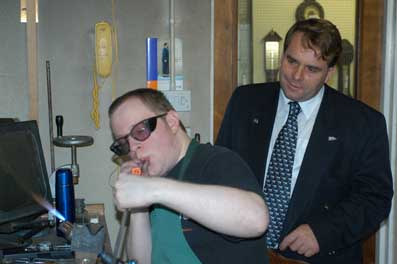 Neil Parish MEP
Watches Andrew make a barometer tube.
Neil Parish MEP
Watches Andrew make a barometer tube.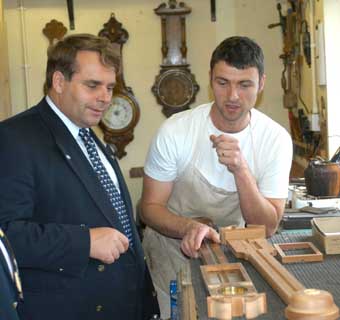 Neil
Parish MEP discusses traditional barometer making with barometer maker Anthony
Neil
Parish MEP discusses traditional barometer making with barometer maker Anthony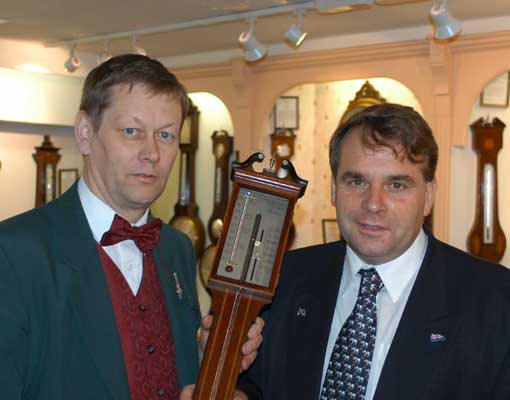
Neil Parish MEP on fact finding visit met international renowned barometer
specialist Philip Collins with one of the hand built threatened barometers
at Barometer World in Devon U.K.ENDSold news items start here
THE LONG LANE
A private publication of local history book about farming and life in Merton before 1938 written by Mark Boutcher Quance of Towell Farm Merton. 200 pages with some hand drawn illustrations and a few pictures. Written by Mark for his grand daughters to record their ancestors and his knowledge of his former days. The family now think the information should be preserved and shared by a wider audience. It is a fascinating account and easy to read. Cost is £10 plus postage (£2 in UK) If you or your family came from Merton in Devon or you just have an interest in local history of Devon then you are sure to enjoy this unique little history. If you wonder why it is on here it is due to our directors personal interest in teh subject and any profit will be going directly to Merton ChurchYard Fund.
FitzRoy
Day
Sat July 9th
Contact:
Philip CollinsBarometer World, Merton,
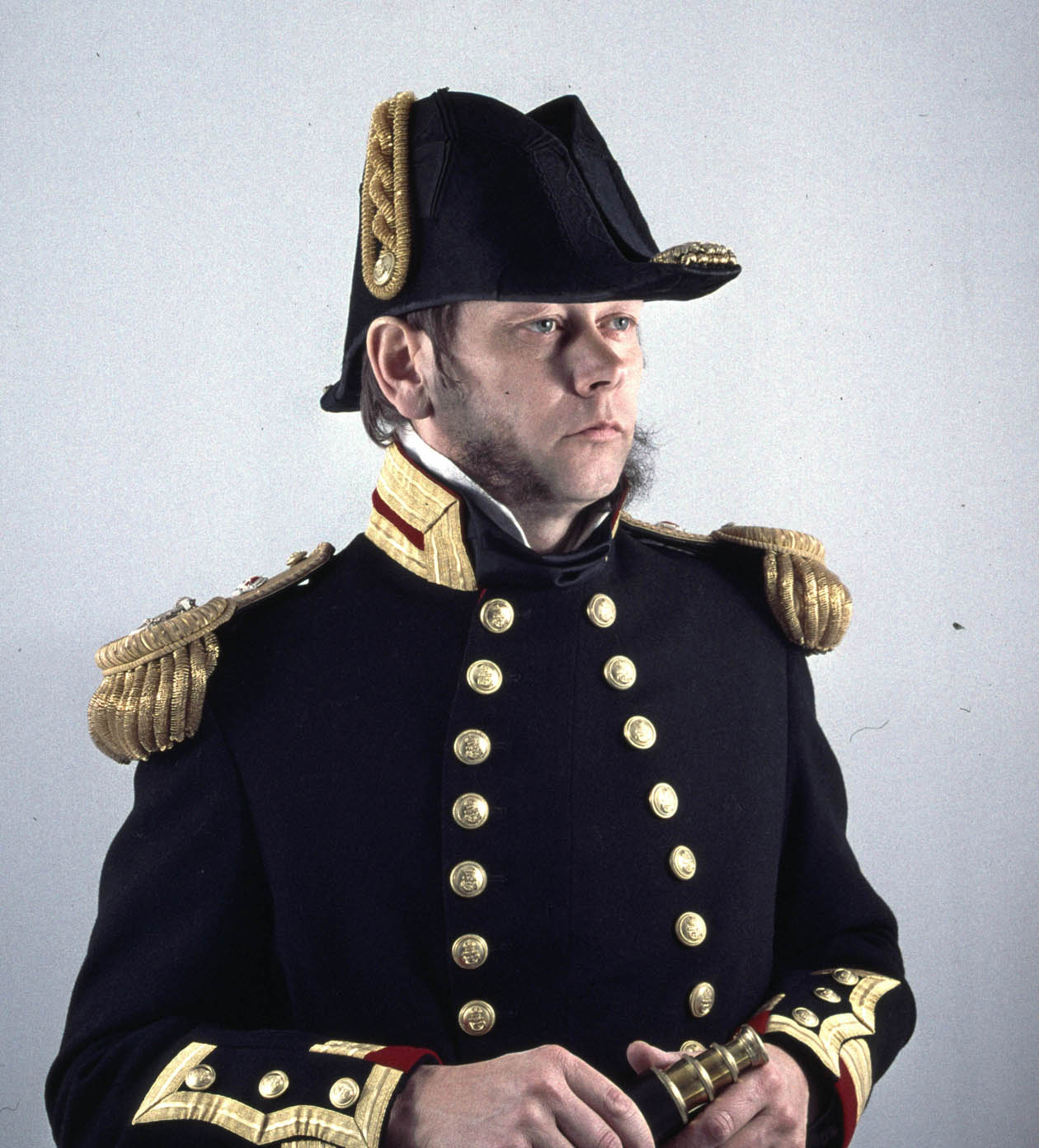
Picture of Philip Collins of Barometer
World as Captain Robert FitzRoy: available for special events and evening
talks.
 Atmospheric
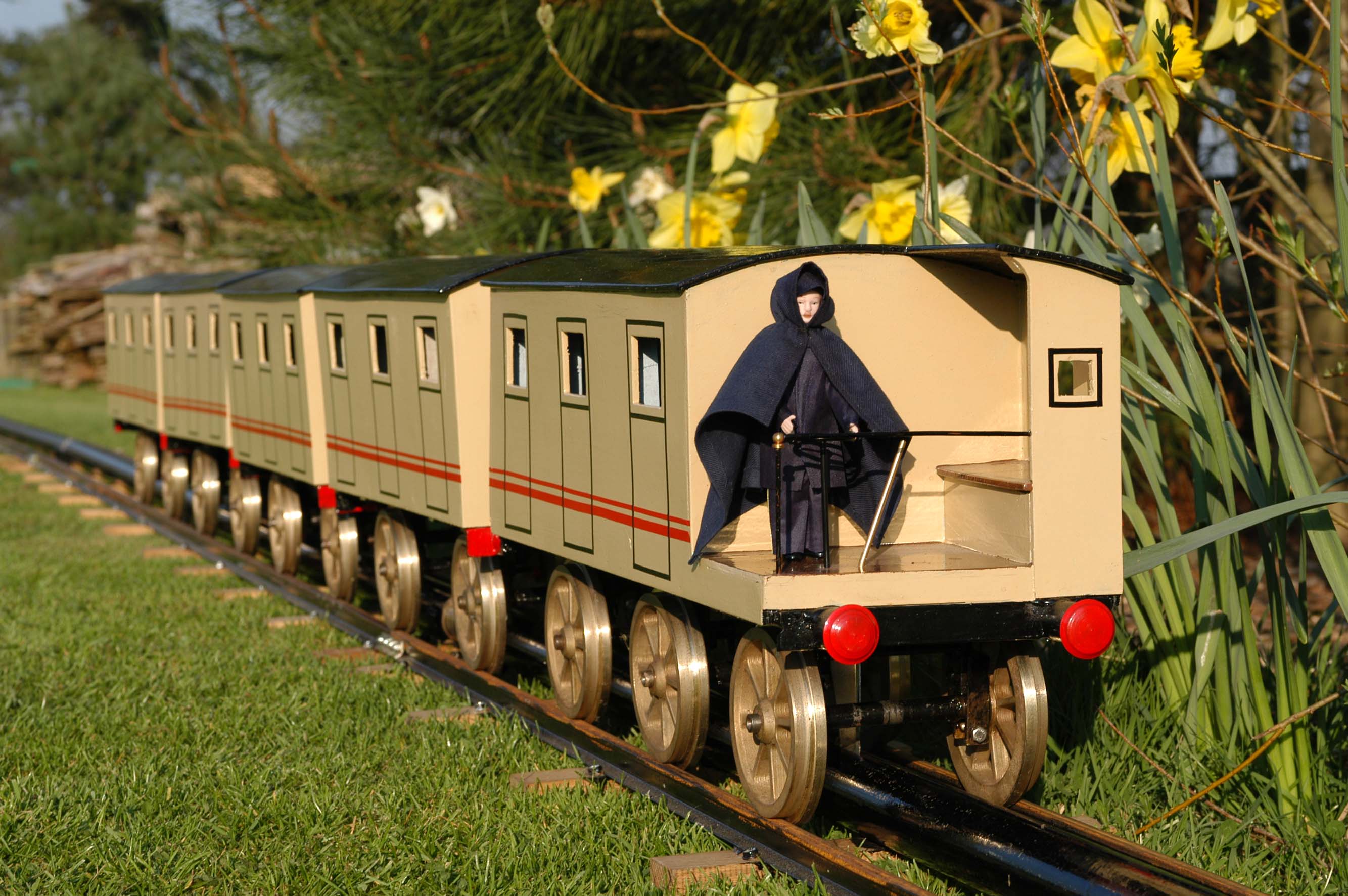
RailwayFirst trial demonstration of Brunnels
atmospheric railway Model took place at Barometer World on 12 April 2003
- Since then a number of dispalys have taken place proving the power of
the atmosphere. The latest public display was at Old Forde House in Newton
Abbot where for the first time for over 100 years people travelled by Vacuum
train! A tremndous succesful day with Barometer World team entertaining
the public with intresting and educational experiments about air pressure
and vacuums.
Atmospheric
RailwayFirst trial demonstration of Brunnels
atmospheric railway Model took place at Barometer World on 12 April 2003
- Since then a number of dispalys have taken place proving the power of
the atmosphere. The latest public display was at Old Forde House in Newton
Abbot where for the first time for over 100 years people travelled by Vacuum
train! A tremndous succesful day with Barometer World team entertaining
the public with intresting and educational experiments about air pressure
and vacuums.
For Sale or Hire
The
Power of Nothing
Brunel's Atmospheric Train, the 'Atmospheric
Caper' of 1847 was recreated at Barometer World in Merton, Devon with an
exceptional working model of the original, built in the 19th
century from Exeter to Teignmouth.Local extrovert, Philip Collins, of Barometer
World, Merton has been researching this unique phenomenon. A train without
an engine! Gliding silently through the countryside on what appeared to
be a largish drainpipe between the rails.
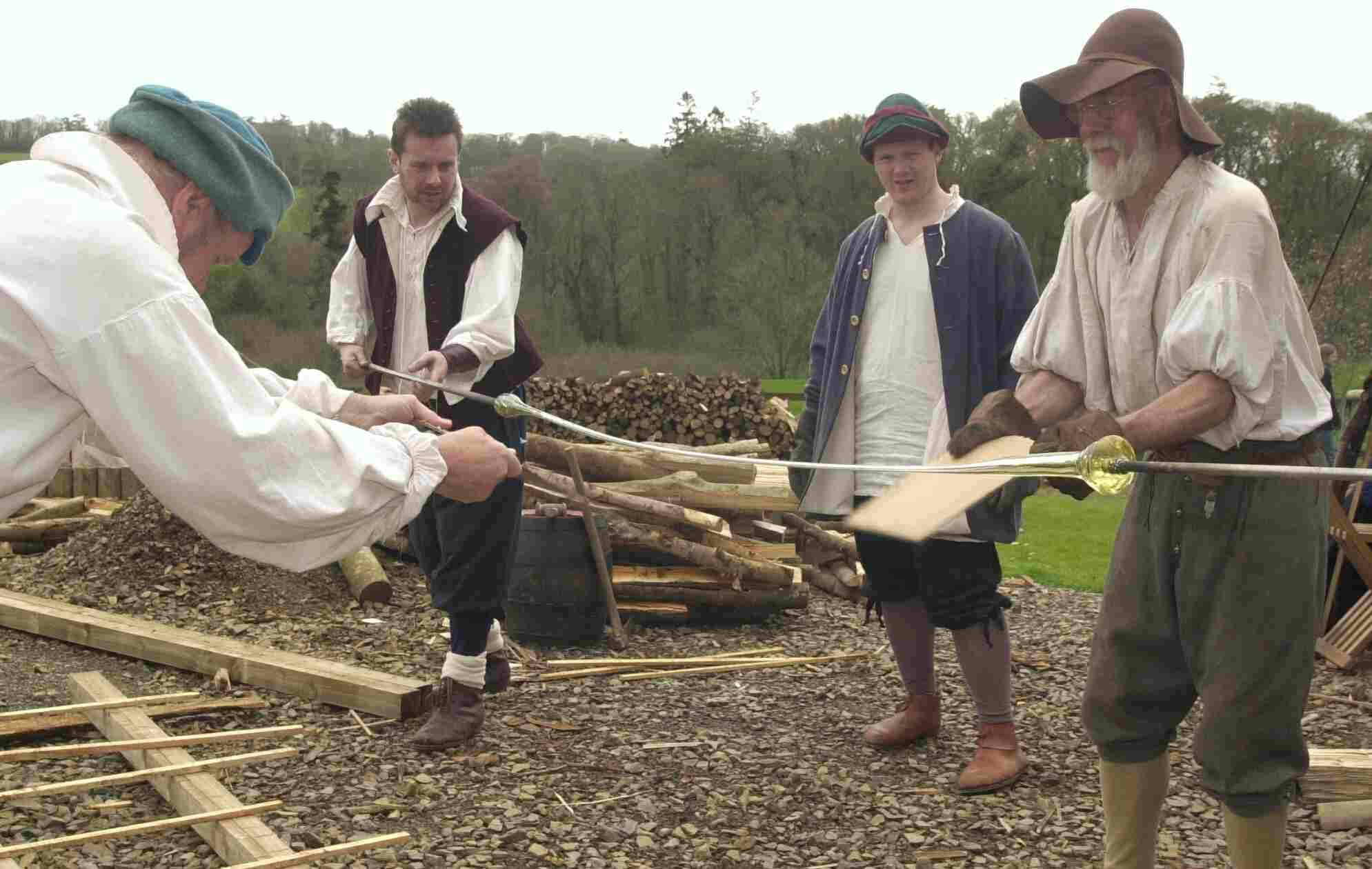
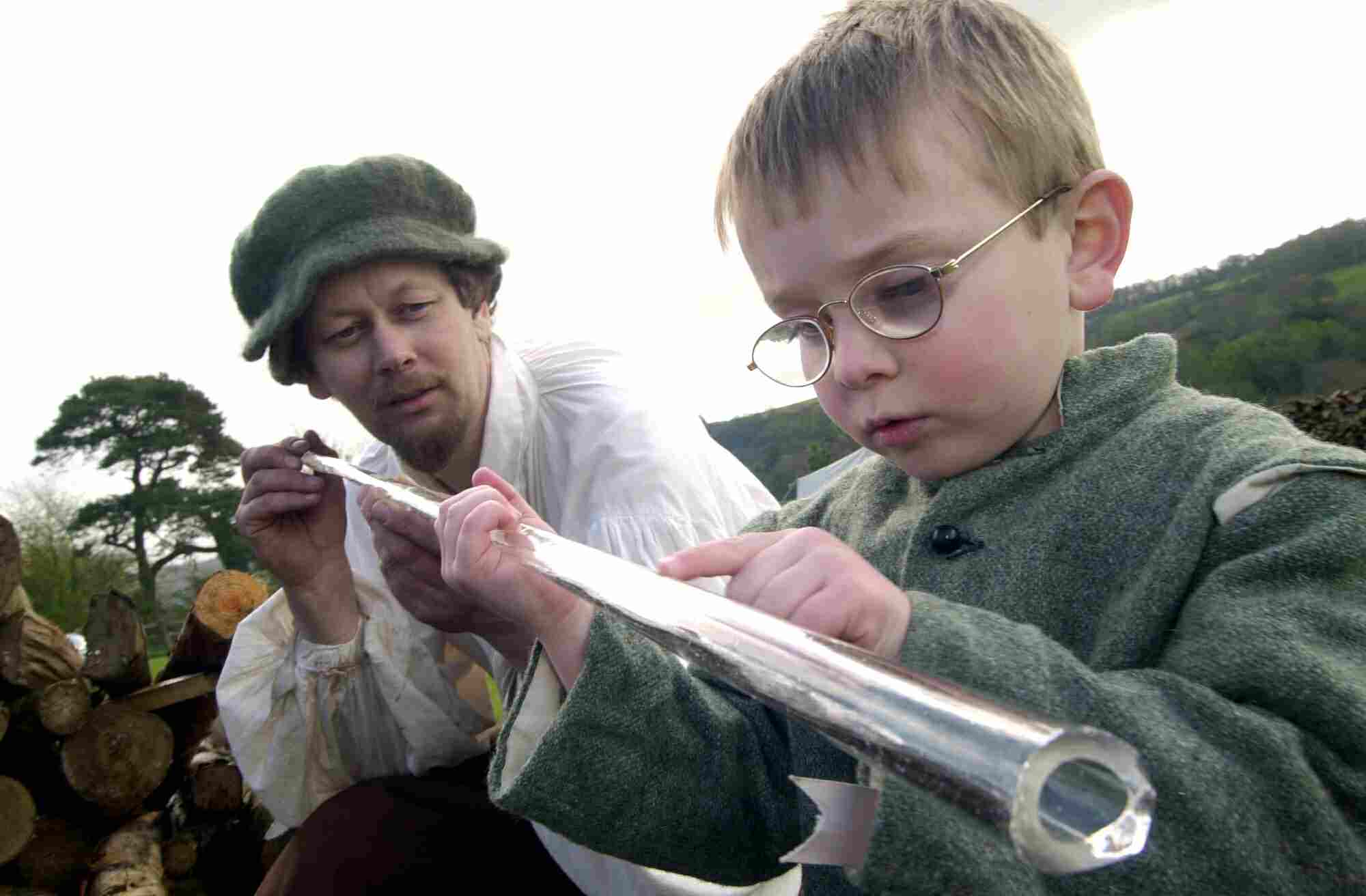
New book on unusual weather predictors planned for 2003.older news here onBarometer Magazine - Great success!Barometer Magazine special edition has been well appreciated by many learned people, even thise not especially interested in barometers have found it 'extremely interesting' Not a boring technical magazine but a highly proffesionally produced magazine to interest all the family!Barometer Magazine - a special edition magazine - (Journal) titled BAROMETERS. This is the first type of Barometer Magazine produced (to our knowledge) Internationally known barometer specialist Philip Collins of Barometer World has written and brought together a number of associated articles and interesting snippets. A must for all keen barometer enthusiasts world wide. . Cover price £4.95 Carriage free ( in U.K.) if bought direct from us. Stockist enquiries welcome.Glass kiln planned to be re fired on Thursday 25th October and a further attempt to make barometer tubes made on Saturday 27th October. Last time we lit we fired only one night, this was to empty the crucible but proved that 24 hours is not enough to find the glass, this time we will plan to fire two nights with one pot of 40 kilos of glass. Glass production will begin (we hope) at about 10.00 a.m. Visitors welcome. Press please contact us on 01805 603443 for times etc.GLASS KILN RE LIT 22nd June 2001 see below for pictures etc.We learnt a lot last time and found that 80 kilos of glass was just TOO much to use, so this time we used one pot with 40 kilos of glass in it. We have enlarged the gathering hole to enable more glass to be gathered for fatter and longer tubes.
An incredible few days were spent towards the end of April when the glass kiln was fired up and at one time reached 1220 degrees C. Considering that it was fired by wood we were very pleased with the outcome of the construction and effectiveness of the heat generated, most of the time it was kept to around 1150 degrees C.
On the Saturday morning the glass was ready to attempt making tubing as they might have in the 17th century.
The whole experiment proved very useful, a few minor changes will be needed to the kiln and next time we hope to produce some even better glass tubing. For fun we pulled one tube as long as we could which measured over 90 feet!!
The following pictures show some of the days work.
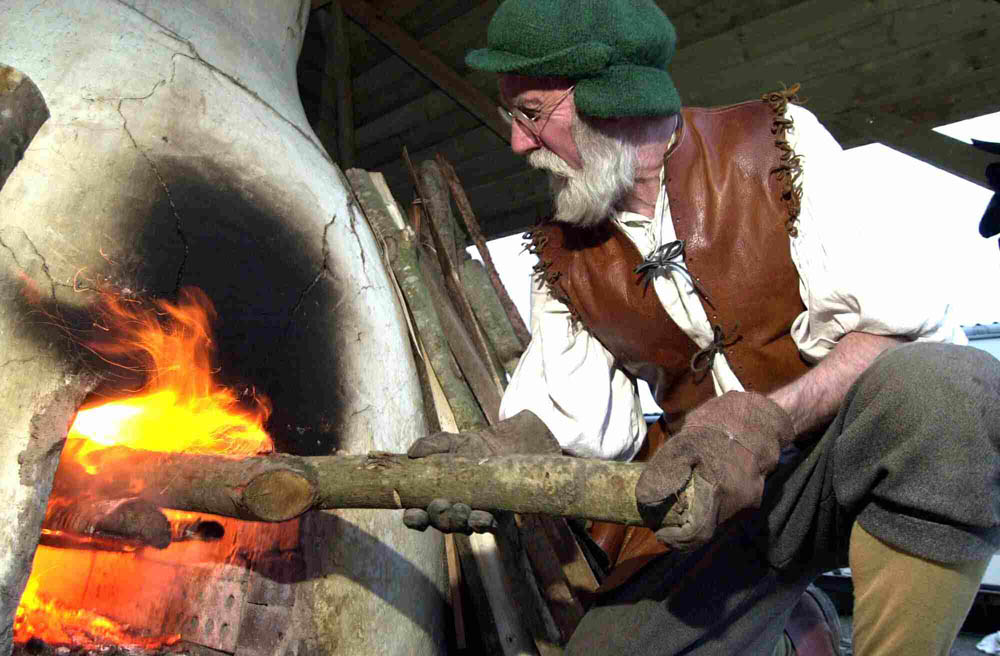
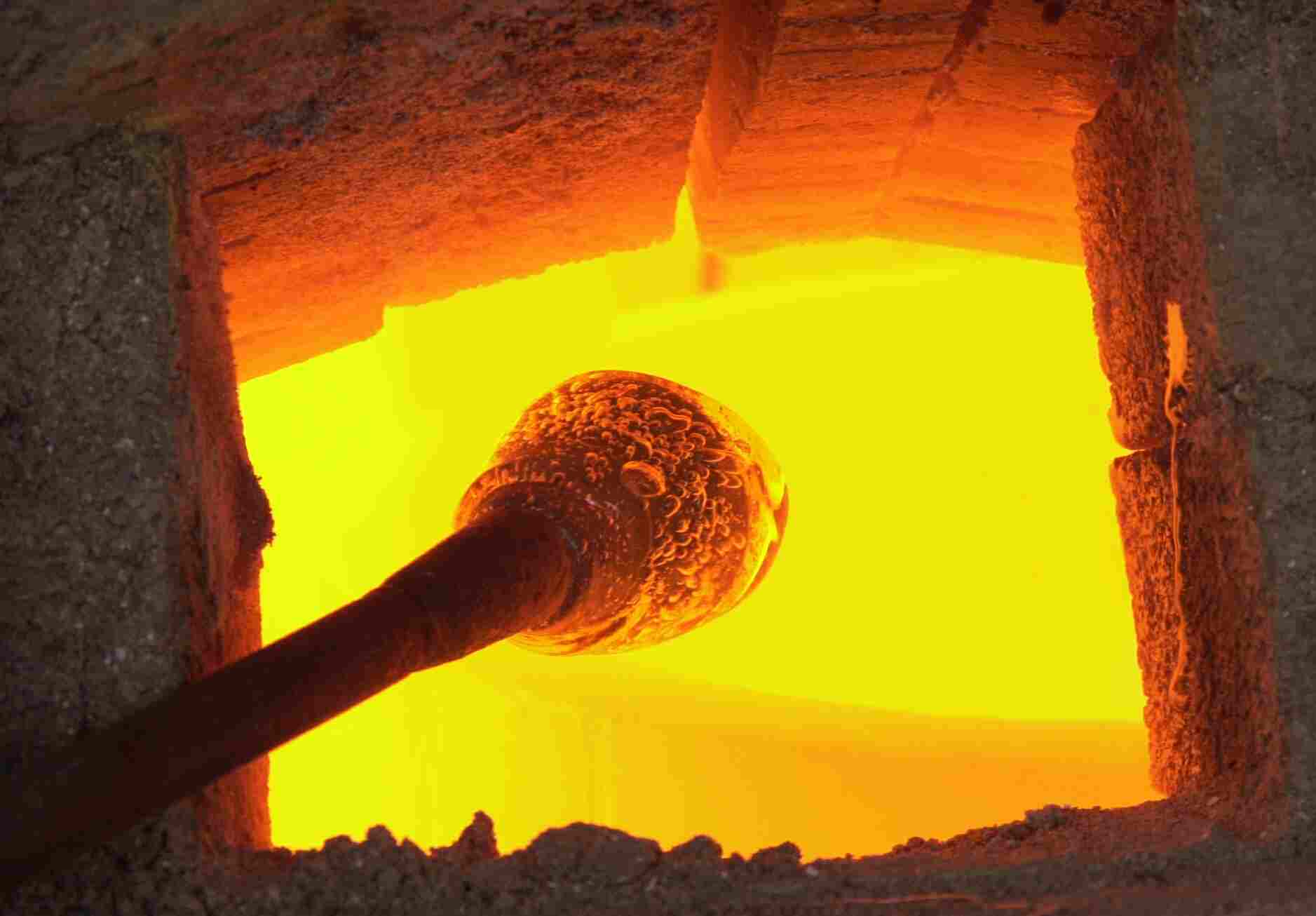
Stoking one of the fireboxes. The glass kiln at working temperature.
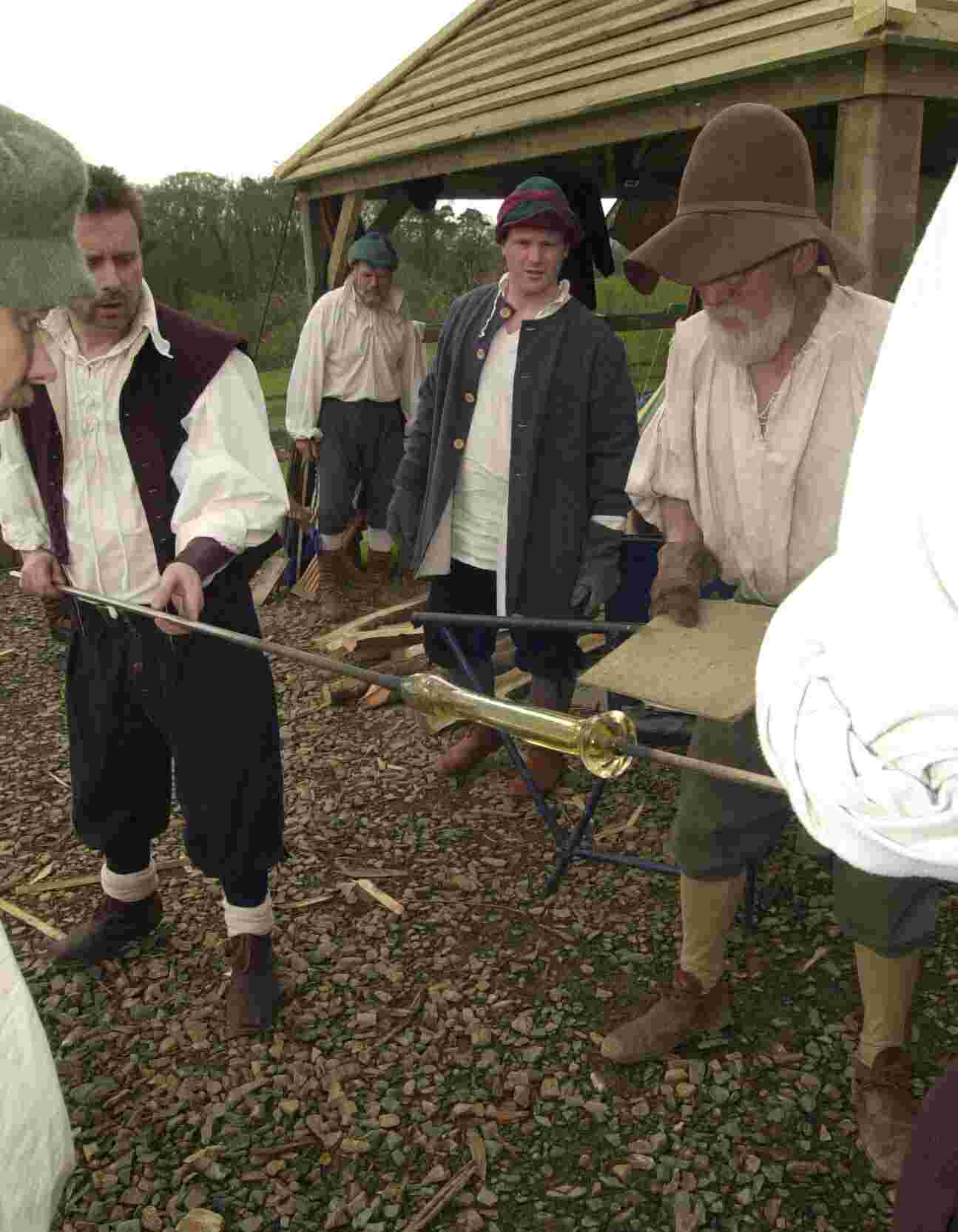
Starting to pull a tube. Pulling a tube .
Inspecting a glass tube made at Barometer World, Merton.
Latest Exhibit unveiled at Barometer World Museum.
Tuesday 27th February 2001 marked the unveiling of our most unusual exhibit ever. Exactly 150 years since the designer and inventor Dr George Merryweather read his explanatory essay before The Whitby Philosophical Society.
A truly unusual curiosity which will fascinate visitors.
THE TEMPEST PROGNOSTICATOR
more details on our information section
17th Century Glass Kiln
NEARLY COMPLETED!
06/01/01
Work on building a 17th century style wood fired glass kiln has nearly finished! at Barometer World.
The kiln is slowly drying out picture show it in nearly completed form. First firing is planned for Thursday 26th and working glass on the Saturday morning if it goes well. Some viewers may query the sense of a wooden structure over it, well as it is not intended to be fired often it needs protecting from at least some rain! when fired a metal liner is planned to be used to take the exhaust heat away and the daub will be painted with lime and linseed oil to give some weather protection around the year.
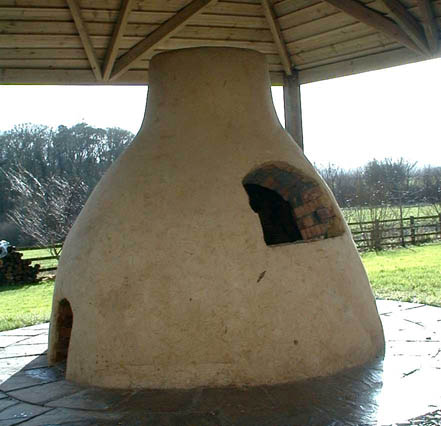
On a miserable wet weekend in November (that is about all weekends last quarter!) some members of Melfords Hys Companie worked hard at completing the structure and coating the whole in a liberal amount of daub to further insulate it when in use. The hovel around it is yet to be finished and a test firing, possible with a load of pottery inside it (pity to waste all that heat!) will be carried out as soon as possible. The unusually wet weather does mean that it will take some time to dry out enough to test it. When completed it will be fired for its first real time perhaps in May but dates are still to be sorted out. Many hands will be needed to stay up around the clock for as much as 48 hours! to allow it to find.
The kiln based on early kiln designs is being being built by specialist Jack Green in a smaller size than original but will be fully workable when completed. To fire the kiln (sometime next year) wood will be used as originally done. It is hoped to learn much about the method of pulling barometer tubing as done in the early days of barometers. After some practice it is also hoped that some usable glass will be produced for special restoration of early barometers.
BAROGRAPH BOOK - UPDATES
30/08/02
Philip Collins long research into barographs has come towards an end, this latest Book on Barographs published by Baros books in 2002, detailing many types of old barographs and helping the dealer and collector to date them by examples and patents surviving. The book gives general hints on caring for them and setting them up etc. As with aneroid barometers Philip Collins discovers there is more to Barographs than may at first be expected!
As with any book more information comes to light after print. here follows some data that may be of interest to onwers of the book.
1.We have been contacted by a couple of people about the Agolini recording barometer. There are at least 3 Agolini recording thermobarometers existing in Italy: at the Brera astronomical observatory (Milan), at the Ximenian observatory (Florence) and in a school collection in Chiavari (Genua). The first of them can be seen at:
http://albinoni.brera.unimi.it/CAELUM/MUSEO/Schede/sch31.html
2. According to an ex employee who visited our museum in 2002, Short and Mason were owned by an American company in the early 1900's Taylor instruments, thus is explained the close links with this American company who kept the name of Short and Mason going strong but often used 'Tycos' as a brand name.
Old news follows here onwards.
further items follow here about the Magdeburg experiment.

1 - 2 - 3 Pull!
Latest update 7th April 2000
1,2,3 PULL!
National Science Week can be praised for encouraging people throughout the country to enter into many types of science projects. This year we were fortunate to be grant aided by Copus, the committee of public understanding of science, to re-enact the complete Magdeburg Experiment. For those readers who are not aware of this it is a 17th century experiment first carried out by Otto Von Guericke in Magdeburg, Germany. Otto Von Guericke, 1602 - 1686, was an incredible natural scientist. In 1654 he designed a vacuum pump to withdraw air from vessels. In 1643 Torricelli had made the first barometer, after taking over notes from Galileo and in those days work on the vacuum was very much in the forefront of pioneering science. It is without doubt that Otto Von Guericke, considered to be the ‘father of the vacuum’, was a showman and he carried out a number of public experiments on vacuums and pressure. Robert Boyle took over much of the continuation and furtherance of his work in Britain.The original experiment grew out of smaller hemispheres and indeed such was the cost of these hemispheres in productions that even the rich Otto Von Guericke could not afford to continue all of this work as he may have liked to. But in 1657 he demonstrated in front of Ferdinand III, and other people, the tremendous weight of air around us. He believed that the air presses down upon us in an almost unseen force. To prove this he evacuated two very heavy large hemispheres, after having placed them together with a leather seal. This leather seal would certainly have had some thick grease or fat, possibly beeswax melted into it to provide an airtight seal. With the use of his newly invented vacuum pump he then evacuated the hemispheres, which stayed together under the pressure of air outside. Using an increasing number of horses he then began to try and pull them apart. Horses at that time were thought to be and recognised as being very strong; they were used daily in ploughing and working the land, as well as for war horses and transport. Von Guericke progressed to 16 horses, although I have heard in later discussions and writings that he was considering using a larger number of horses.
On Saturday 18th March we at Barometer World organised this re-enactment on the Old Bowling Green at Torrington. Despite being aware of the experiment, and having seen photographs and a video when it was performed in Germany previously, this was the first time ever in the United Kingdom that this experiment took place with 16 horses; it is only seeing the experiment in the flesh that brings home the tremendous forces involved in holding the spheres together. With the 16 horses accustomed to daily working on farms, brought together especially for this occasion, pulling and straining to pull the hemispheres apart one really gets a feel for this immense weight of air around us in which we live all the time and in which the daily variations are indicated on the barometer, which itself indicates the approaching weather changes. Fortunately on the day the weather was dry. In the morning it was slightly overcast but lovely and sunny in the afternoon. The pressure was high at 1035 Mb, further ensuring that the hemispheres would be held firmly together. Very occasionally they will pull apart due to low pressure, particularly at high altitude and if the horses pull with exceptional force. Before the main experiment a number of small experiments were conducted with children pulling on small hemispheres and eighteen men pulling against two horses. In the afternoon the horses easily overcame the strength of eighteen men. It was experiments such as these that encouraged early scientists, and indeed meteorologists to study the air pressure changes and to interpret the wonderful weather, which fascinates so many of us today. Next time you look at your barometer try and remember that it is indicating the current pressure but that normal average pressure is about 15 lb. per square inch pressing down. We are used to this phenomenon and indeed we would suffer greatly if the pressure reduced. Our whole being depends on this pressure and the air that we breathe.
ENDS
This update 24th March 2000
Well the whole day went very well. Thanks to so many that helped before and on the day including my re-enactment friends that helped set the scene. Jack Greene was excellent in his role as commentator, well over 3000 people turned out to see the experiment, and some even took part.
The morning was good, but the afternoon was terrific. The sun came out and horses and handlers and even Jack Greene new what was happening, it all went very well.
More detailed photos for magazine use can be supplied if requested. I think about 10 rolls of film were used on the day by us so there are some good pictures.
Further to a visit this weekend by Ditmar Schneiderm, Dr. Manfred Troger and Peter Streitenderger all of the Otto von Guericke Society, they have agreed in principle (subject to contract) to come back in March and perform the Magdeburg Experiment with their hemispheres. The ones they use are fairly new copies costing about £8500. They will come over as a group of at least 7 to carryout this experiment. They enjoyed a weekend in Devon whilst looking at some of the horses and harness that would be used and the site intended on Torrington Common. They also took the chance to visit briefly just a few places in the area.
Further information from: Philip CollinsTel: 01805-603443Fax: 01805-603344
E-Mail press@barometerworld.co.uk
SO WHAT!
So what’s the point of attaching 16 horses to a large ball and persuading them to play tug-of-war with it? It’s all been dreamt up by that chap at Barometer World – so the chances are that it’ll have something to do with …………. Barometers? Everyone knows that they’re pretty fragile things, so there’s obviously not a barometer inside. So what’s the point? In fact there’s nothing inside at all – completely nothing – a total vacuum. The sphere has been made in two halves, which have been carefully lined up with each other and then held in place while all the air is pumped out. After that they don’t have to be held anymore – so they stay sucked together. (Yes that’s sucked together, not stuck together as in glue.) But all you have to do to break them apart is to give them a good tug! Well how much of a good tug?
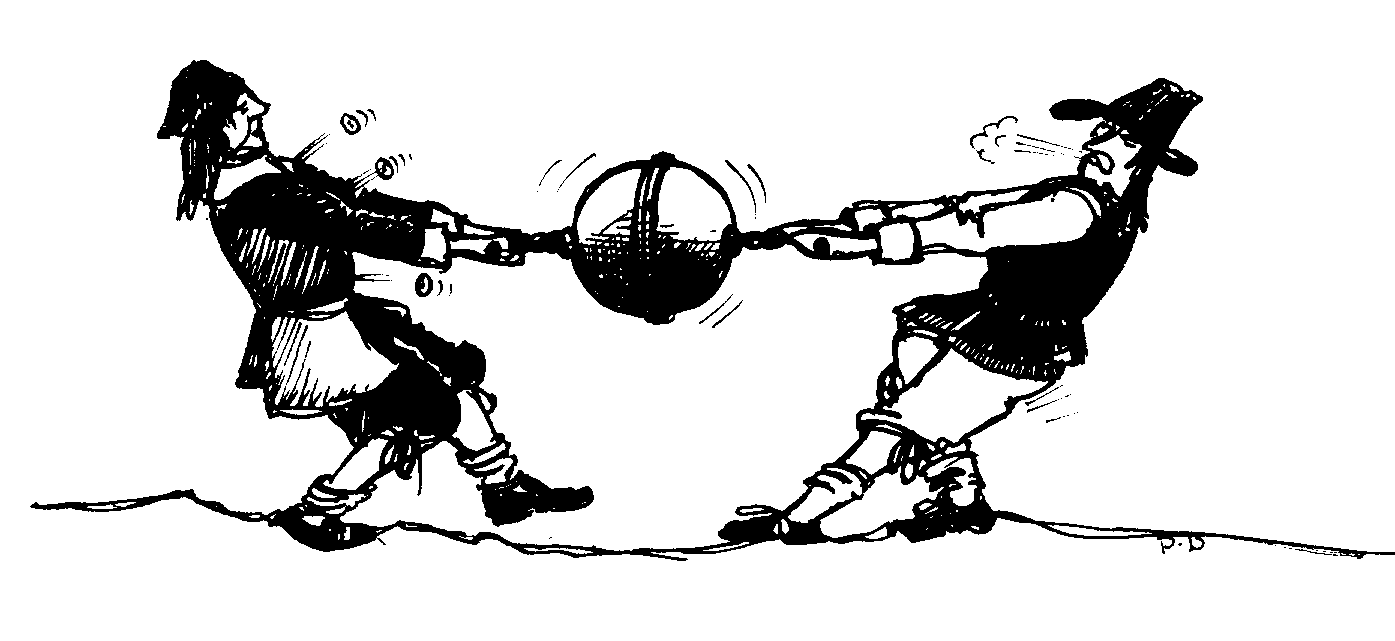
Perhaps one hand on each side? Or a person on each side? Surely a couple
of strong men should do it?It so happens that Otto Von Guericke was intrigued
by this question back in 1656. 
He did some sums and reckoned it would take several horses, pulling with
all their might, to break apart a 62cm diameter globe. 
His friends then did some reckoning of their own and decided he was daft
so he put the ball in their court (so to speak) and set out to prove it.
His calculations were based on the knowledge that air presses down.
We’re not aware of this, but every square centimetre of our skin has
1.09 kilos pressing on it. The sphere has a total of about 3294 kilos acting
on it! Normally this is exactly balanced by the air inside, but if you take
the air out.. .. well, all that pressure keeps the two halves firmly together.
That’s also why he chose a sphere for the experiment as any other shape
would probably buckle. So was he right? Well that, as they say, is history!
Here are some experiments that you could try for yourself. They won’t take as much preparation as 1,2,3 – pull!
- Get a plastic 1.5ltr lemonade bottle and drink the contents. Then immerse it up to the neck in hot water. Don’t let water get inside. Wait for a couple of minutes while the air inside warms up – this makes some of the air leave the bottle (a partial vacuum). Quickly replace the top and remove from the hot water. Soon the bottle will start to buckle as the air inside cools down and contracts, allowing the outside pressure to act on it. This works with plastic milk containers too. Use any plastic bottle and a ‘wine saver’ device (they extract the air from opened wine bottles to stop the rest spoiling). Pump out the air and watch the bottle collapse as flat as a pancake! Put a ruler on the table, leaving a bit of it sticking out over the edge. Put a sheet of paper over the ruler, but not over the bit that’s sticking out. Now give a smart hit to the end of the ruler. You should find that it’s quite difficult to make the ruler move. Why? It’s because that sheet of paper has many kilos of air pressure on it, so when you hit that ‘lever’ you’re trying to move much more than a sheet of paper! So what’s the link with barometers? Well, barometers measure the weight of the air (which changes in advance of the weather so they can be really useful things!) Look at a Barometer to see how much pressure is on you today. It will be something like 1 kilo on every square centimetre of you, or about 6000 kilos altogether. Feeling squashed? Lastly – everyone knows that air pressure gets less as you go higher. At the top of mountains, for instance, there’s hardly enough air to breathe. So it must be true that there would be less pressure to hold together that sphere. And probably it would take fewer horses to pull them apart! In order to prove this one way or the other, Phil is bidding to get funds to repeat this experiment on the top of Everest. The date planned is 1st April 2001 – see you there!
Information and fact file:
Our atmosphere (air) extends to approximately 600 kilometres above
the ground.At high altitude (low pressure) water boils at much lower temperatures
but it is not hot enough to cook with.Meteorologists plot points of equal
pressure to produce the isobar charts.Evangelista Torricelli made the first
barometer in 1643, using mercury.Barometer World has a collection of over
300 different barometers.Barometers can be used to measure altitude.Barometers
are still the single most useful tool to predict the weather changes.Barometers
have been used on the moon – the pressure is about 24 millibars. On
earth an average is about 1000 millibars.Weather houses react to moisture
in the air.Wild oats can be used to indicate moisture change.Some people
suffer from aches and pains during bad weather or advancing bad weather
– they could perhaps be called human barometers, as they may be more
sensitive to pressure changes than the majority of us.Links:
http://www.uni-magdeburg.de/org/ourg
http://www.bbc.co.uk/history
http://www.britassoc.org.uk/
I hope you have enjoy watching our performance. It has always been intended as a fun occasion to demonstrate a very simple but little understood fact that there is tremendous force in the weight of the air we live and breathe in. It indeed took me many years before I began to understand it. Working with barometers as we do at Barometer World there are many interesting facets to barometers and the discovery by Evangelista Torricelli in 1643 was one of the most important discoveries of our times. Curiously people discussed what the gap at the top of the barometer was, which we know today is a vacuum. At that time it was thought impossible to have a vacuum – they thought gases came through the glass itself, or spirits through the mercury. Our experiment at the North Devon Show in August 1998 utilised the wine barometer that Pascal built to prove that it was spirits percolating through. For those of you who missed that I hope to perform the experiment again at some later date. You may ask what is National Science Week. This is a week exploring science, engineering and technology each year from 17th March. COPUS, the committee on public understanding of science, is a joint initiative of the Royal Society, Royal Institution and the British Association, promoting a better understanding of science, engineering and technology in society. They have been supporting this exciting re-enactment here today with the aid of a grant. Throughout the county this week there will be many hands-on experiments, talks and lectures and much much more.
Otto von Guericke was born in 1602 (died 1686) he is considered the Father of the Vacuum. He studied natural science and is best remembered for his public experiments with hemi-spheres and horses. He was also a very important states man. He worked with the Swedish army as an engineer in his earlier years. He planned the rebuilding of his home town Magdeburg after its destruction during the 30 years war. He was Mayor and a highly important civic dignitary. His experiments were wide ranging including early electrical experiments using a sulphur ball. His vacuum experiments set the pace for many scientists that followed. There is a special exhibition be planned in Magdeburg of his life and work during 2002 the 400th anniversary of his birth.